
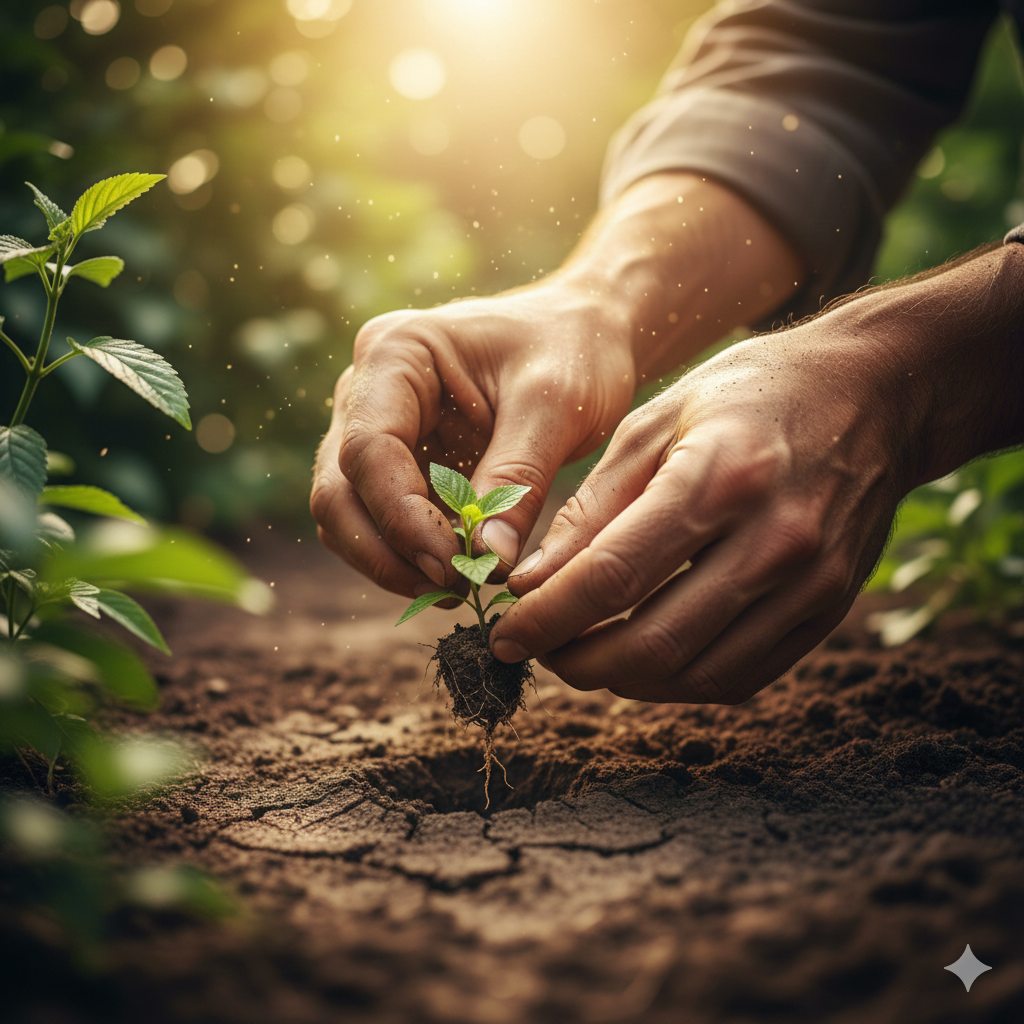
Not all soil is good for growth—but every seed was made to grow. A wise gardener knows that the health of a seed depends not only on the structure of the seed itself but also on the soil in which it is planted. A seed may hold the potential for life, beauty, and fruitfulness, yet if it is buried in polluted, rocky, or dry ground, it cannot thrive. Because truth is…. Soil matters.
So the question is: Where are you planted?
In life, many of us may have once been planted in the toxic soils of hurt, anger, or sin—places where growth felt impossible. Perhaps you grew up in a family where shouting was louder than laughter, where harsh words cut like weapons, and where love was buried beneath cycles of conflict. Maybe the home that should have been your refuge felt more like a battlefield—marked by physical blows, verbal wounds, and emotional scars. For others, it may have been through friendships or peers that promised belonging but instead brought pressure, betrayal, or harmful influence. Maybe the very people you trusted to stand with you became the thorns that pierced you. And perhaps the guilt and shame, the fear, the pain, bitterness, disappointment, or neglect that surrounded you began shaping who you are and left you with little room for hope and joy to take root. Like a seed pressed into barren ground, you may have sprouted, but each attempt to grow seemed strangled by thorns and shadows.
Yet the story of the seed does not end with its struggle. Because into all these barren places where we once attempted but failed to grow, Jesus comes as the Master Gardener who does not abandon His children to wither where they were first planted. In His mercy and grace, He carefully uproots us from the ground that stunted our growth and transplants us into His garden. Here, His Word nourishes us, His presence becomes our light, and His Spirit waters us with life abundant. Finally—we can thrive. “The righteous will flourish like a palm tree, they will grow like a cedar of Lebanon; planted in the house of the Lord, they will flourish in the courts of our God” (Psalm 92:12–13, NIV).
The transformation is rarely instant. We may still carry the residue of our old soil—insecurities, fears, brokenness. Yet over time, the toxins of the past begin to fade, replaced by the richness of His truth and love. Suddenly, what once seemed impossible begins to bloom: peace where there was anxiety, forgiveness where there was bitterness, and joy where there was despair.
This is the work God longs to do in each of us. His presence is the soil where our souls can truly grow. In Jeremiah 17:7–8, we are given a picture of this kind of rooted life:
“But blessed is the one who trusts in the Lord, whose confidence is in Him. They will be like a tree planted by the water that sends out its roots by the stream. It does not fear when heat comes; its leaves are always green. It has no worries in a year of drought and never fails to bear fruit.”

Notice that it is not our strength that allows us to thrive, but our location. When our roots are in Him, we find a constant source of life, even in seasons of drought. In His garden, we are not defined by the soil of our past but by the Gardener who tends to us with unfailing love.
Jesus Himself declared in John 15:5, “I am the vine; you are the branches. If you remain in me and I in you, you will bear much fruit; apart from me you can do nothing.” To grow is not to strive harder in poor soil but to remain connected to Him, abiding in His presence where life flows freely.
Being transplanted into God’s presence is more than survival—it is transformation. In Galatians 5:22–23, Paul describes the fruit that grows when we walk in the Spirit: “love, joy, peace, forbearance, kindness, goodness, faithfulness, gentleness and self-control.” These are not the products of human effort but the natural fruit of being rooted in Christ.
What once was anger can be replaced with gentleness. What once was bitterness can bloom into kindness. What once was despair can blossom into joy. In His garden, we flourish—not just for ourselves but as living testimonies of His power to redeem and restore.
So again—where are you planted today? Do you feel your roots still tangled in the soil of bitterness, fear, or shame? The good news is that God is still in the business of transplanting seeds. He is able to lift you out of the barren ground and replant you where His living water flows. Growth may take time—because roots deepen slowly, and leaves unfold gently—but in His garden, there is life.
And when storms come—and they will—you will not be shaken. Because your strength was never in yourself, but in the One who planted you. In due season, your seed will blossom—not for its own glory, but for the glory of the Gardener who made all things new.