
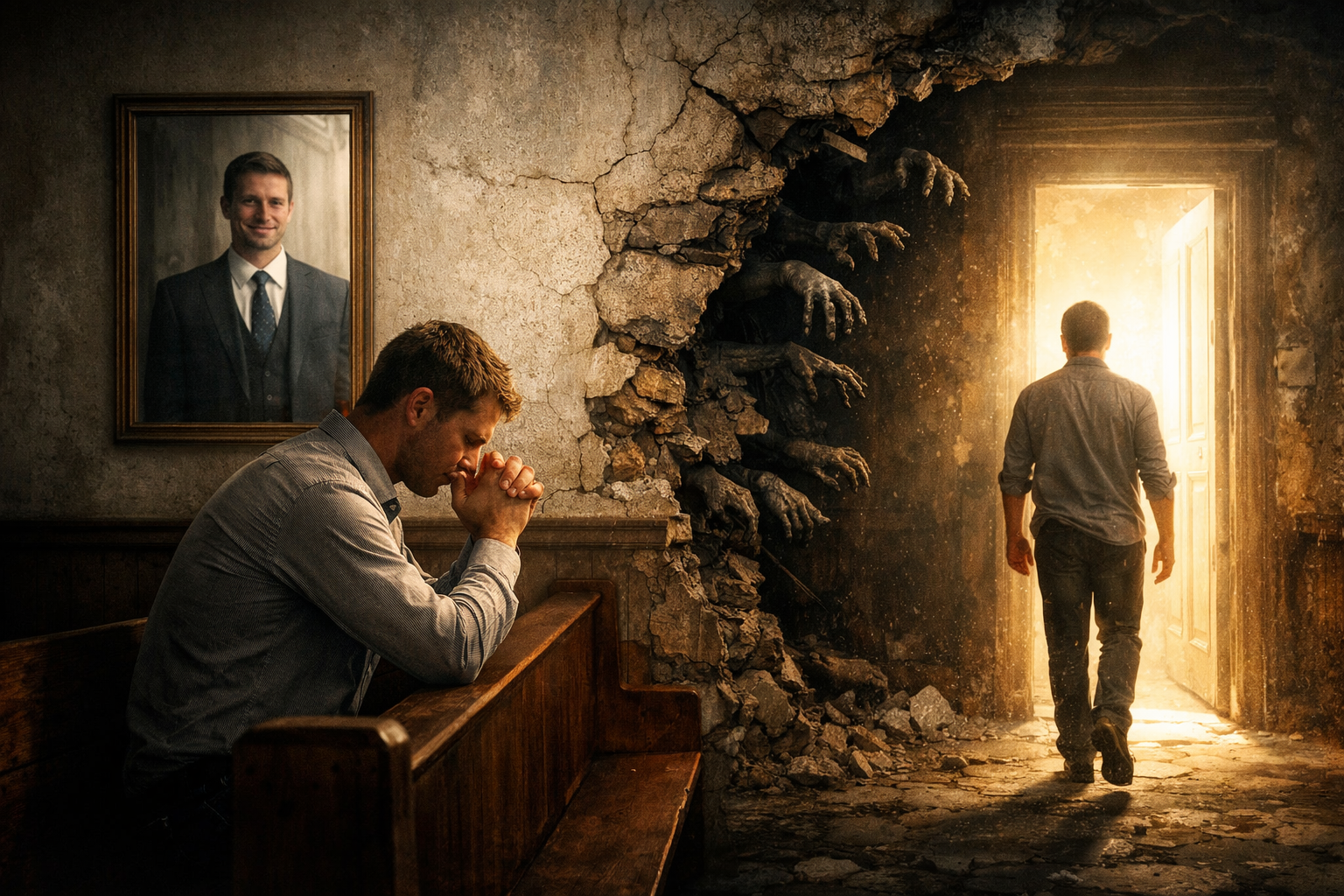
“Is holiness a dress I put on, or a life I live?” is a question one might dare to ask in the course of their Christian journey. Too often, we struggle with our own holiness, wrestle with doubts in our faith, and feel the tension between who we are inside and who we appear to be outside.
Some of us seem to have learned how to wear holiness well. From the outside, we look like what a Christian should look like—cheerful, polite, gentle with words, patient, prayerful, one who reads and studies the Bible, and always present in church. It looks convincing. It almost feels convincing. So people believe the story of our faithfulness, our holiness, and how clean our hearts are—just like our appearances.
But holiness can sometimes feel like a garment—something slipped on when people are watching and folded away in the privacy of our own hearts. Behind the careful exterior, there is often a different story: thoughts we are ashamed of, habits we hide, prayers uttered with a strange mixture of faith and guilt.
Everyone around us seems clean, sincere, steady in their walk with God, while we carry a silent fear that if someone looked closely enough, they would see the rot beneath the fabric of holiness we’re wearing. We imagine the moment of exposure—the moment when the version of ourselves that people believe in collapses.
So we try harder to look holy.
We keep our failures hidden, sealed away behind polite smiles and disciplined habits.
It becomes a strange performance: appearing devoted while quietly wrestling with the parts of ourselves that refuse to be.
Jesus once spoke to people who were very good at appearing righteous. He said,
“Woe to you… for you are like whitewashed tombs, which outwardly appear beautiful, but within are full of dead people’s bones.” — Matthew 23:27
It is a frightening verse because it sometimes feels uncomfortably close to describing us.
The strange thing about shame is that it convinces us that hiding is the same as surviving. As long as no one sees, we can still belong. As long as no one knows, we can keep sitting in the pew, keep acting holy, keep pretending we are whole.
But hiding also builds distance—
distance from people,
distance from honesty,
distance from God.
Have you had moments in prayer when you realize you are still trying to impress the very God who already sees everything?
Scripture says,
“Man looks on the outward appearance, but the Lord looks on the heart.” — 1 Samuel 16:7
Which means the performance was never convincing to begin with. God was never fooled by the polished version of us. He saw the jealousy, the pride, the secret sins, the unholy thoughts we tried to bury, the prayers that came more from habit than hunger. And still, He listened.
Don’t you think there is something unsettling about that kind of knowledge? To be fully seen and not immediately rejected feels almost suspicious, as if we’re just waiting for the moment when His patience finally runs out.
But the gospel tells a different story.
When David wrote Psalm 51, he was not writing as a man who had kept his record clean. He had fallen badly—into adultery, deception, and the kind of moral failure that would stain a reputation forever. Yet his prayer did not begin with pretending he was still righteous. It began with a confession:
“Have mercy on me, O God…
For I know my transgressions,
and my sin is always before me.” — Psalm 51:1–3
David did not try to polish the truth. He simply brought his brokenness into the light. Maybe that is where faith actually begins—not in appearing holy, but in finally admitting that we are not.
Many Christians might quietly be carrying the same fear: that they are the only ones struggling while everyone else has learned how to be pure, that they are the only ones sitting in church with secret battles, secret guilt, secret shame.
But grace is real, and that teaches us that the church was never meant to be a room full of perfect people. It was meant to be a gathering of the forgiven. The apostle Paul once said “Christ Jesus came into the world to save sinners—of whom I am the foremost.” — 1 Timothy 1:15
Not was. Am. Even Paul did not speak like someone who had graduated beyond the need for mercy.
And maybe that is the truth we should keep learning: that the Christian life is not the construction of a flawless person. It is the full surrender of a flawed one. The hypocrisy we fear most is not that we still struggle with sin—it is the temptation to pretend that we do not. Because the moment we stop pretending is the moment grace finally has somewhere honest to land.
So we shall continue to go to church, and do what a Christian is meant to do—not to meet the expectations of others of us, but at the pace of our own spiritual journey. Not because our faith is weaker, but because we are finally learning that God was never asking for the performance of a saint. He was asking for the honesty of a sinner willing to come into the light.