Seventh-day Adventist Church grew from the thought of not sending missionaries to foreign countries to sending missionaries to foreign countries. There are a lot of missionary-sending organizations that exist today while there are none to send out missionaries until the 1870s and 1880s. It is always noteworthy to remember the pioneers who gave themselves for this mission even when there are no sources for them.
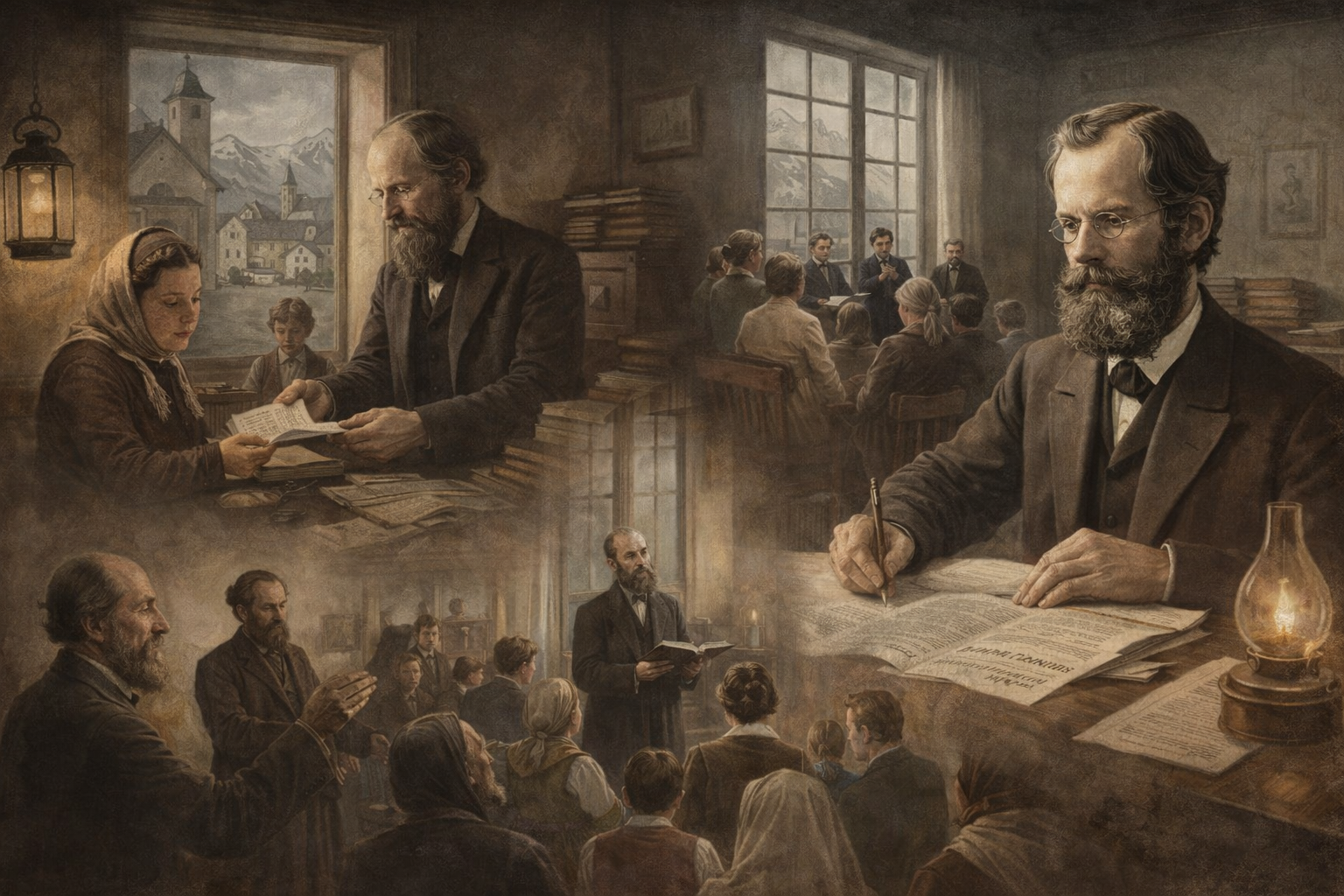
The mission started by Czechowski who went as an unofficial missionary to Europe preaching the Seventh-day Adventist message, prepared a way for J N Andrews to continue forward. As an American living in a foreign country is not easy for Andrews but he made his message reach many parts of Europe by learning languages and publishing papers and magazines. Seeing the people like sheep without a shepherd, Andrews took another mile to bridge these gaps by connecting people through visitations, church services, and evangelistic campaigns.
The church should also understand the financial difficulties that Andrews went through in his years of missionary experience in Europe. He chose to be poor over being rich and his diet and his house with no sanitation explain his contribution he made to the church and mission. However, his dedication is a blessing to the Church.
The forerunner Czechowski and his mission, a groundwork laid for Andrews
Michael Belina Czechowski was the first Adventist unofficial missionary to Europe. Converting from Roman Catholic minister and Protestant pastor to Adventist minister made Czechowski understand the trueness of the message of the Seventh-day Adventist Church and its mission. On his denial by the church to send him as a missionary to Europe, he took a further personal step to go as a first unofficial missionary and gave roots to the Adventist message in Europe. Being a European, serving people in his context made a great impact in sharing his message.
After the arrival of J. N. Andrews to Europe, he admitted that “Czechowski was a Seventh-day Adventist minister, a noble-hearted man, an upright man, and one that feared God”. Moreover, commenting on Czechowski’s abilities Ellen White commented that he is “differed in many ways from his co-workers and fellow believers, in background, talents, interests, abilities, and experience. education, ideas, and spirituality. All this was readily recognized. But only too few could appreciate it.”
Andrews’s mission in Europe: Language barrier, his church and house visitations, publishing the paper
Language barrier: The very initial challenge that Andrews faced in Europe was the language barrier. It is said that not understanding anyone’s conversation is very frustrating to him. Sadly, his translator Vuilleumier’s translation caused more confusion in the gatherings. To solve this issue Andrews and his family decided to ban English speaking in the house except morning 5-6 and speak only French throughout the day.
House and church visitations: The church back in America thought that Andrews had less time for house visitations. To such accusations, Andrews commented that “I go out regularly and spend sabbath and the first day of each week in meetings speaking 5-6 times, then give rest of my time to the paper”. His visitations and gatherings established a good number of believers in the church. He even conducted several Evangelist campaigns.
Publishing paper: Andrews’s publishing paper and tracts made Europe understand the prophecies. Learning the languages and writing and publishing became one of the prominent works of Andrews. His papers connected the sabbath keeping believers living in various parts of Europe. He kept as a principle that printing a monthly magazine in French was a goal. By 1884, the number of believers increased from 75 to 200 members, and through papers the message reached many parts of Europe.
Andrew’s finance, poverty, diet, health and death
“When Andrews began his European work, his salary was $14.93 per month. . . In reality, Andrews was not paid a regular salary during the time he spent in Europe. In view of his hesitation in using the mission’s funds, this fact may have contributed to some of his personal financial struggles.” Because of this, he has no personal funds to spend for himself.
It was also said that to help others with money and food and for ministry, sometimes Andrew spent much of his money which made his family go short. His diet was bakers’ bread, potatoes, graham puddings, and occasionally cabbage. This poor diet and poor sanitary conditions caused his sickness and he was attacked with Pneumonia in 1877. Finally, on October 21, 1883, Andrews fell asleep. On his death bed, the last thing he did was, write a cheque of $500 to ministry, the last wealth he possessed.
A Life Given, A Mission Continued
Though the early Seventh-day Adventist Church didn’t understand much of what Andrews did through him a big door opened now for Adventist mission in Europe. Though it seems too small in human eyes, God has ways to accomplish His work through various means and various people. Our availability is God’s ability.
The moment he came to Switzerland he said that he was willing to give his life for the sake of the mission and truly he did that. He lived for a mission and despite challenges, health, loss of family, and poverty he chose to serve others which left him no money to spend for himself yet he bore for Christ. Today there are 178,566 Adventist believers in Europe, from Portugal to Germany. The Lord works with His people to reach His people.
BIBLIOGRAPHY
Leonard, H., & Andrews, J. N. (1985). J.N. Andrews – the man and the mission. Andrews University Press.
Knight, G. R. (2012). A brief history of Seventh-Day Adventists (3rd ed.). Adventist heritage series. Review and Herald Pub. Association.
Schwarz, R. W., & Greenleaf, F. (2000). Light bearers: A history of the Seventh-day-Adventist Church (Überarb. Aufl.). Pacific Press Publ. Assn.