
Have you ever, as a child—full of curiosity, wonder, and perhaps a little recklessness—cut your skin deeply? The sting was sharp, the blood flowed freely, and you cried out in pain. Time passed, the wound closed, but the scar remained—a raised, rough, and often ugly reminder of that moment.
Life is much like that, isn’t it? We begin whole and innocent, but pain sometimes cuts deep into our hearts. Betrayal, loss, and rejection—they leave their marks, wounds that bleed and ache. Eventually, the bleeding stops, but the scars linger, telling stories of what we have once endured.
Scars are strange things. They tell truths we often try to forget. They prove that something once tore us open—and yet, they also prove that we did not remain broken. We trace them with our fingers and remember the pain, but seldom do we notice the quiet miracle beneath—that healing came, that life that still flows, and that Someone tender and compassionate bent low and entered through our wounds to meet us there.
What if the very places we call “ugly” are the doorframes through which God has most tenderly entered? What if the cracks in our souls are not barbed wire to keep Him out but thresholds through which His light spills in? We spend so much of our lives wishing away our hurt, begging Him to erase the evidence of it, unaware that these marks—jagged, imperfect, permanent—are the signatures of His visitation.

There was once a girl—so broken, so lost, so overwhelmingly hurt—that she found no one to turn to. No shoulder to cry on, no comforting voice that would encourage and give hope. Loneliness wrapped around her like a cold shroud, and pain and hopelessness dwelt in her heart. She carried wounds invisible to the eye but heavy enough to crush her spirit. No smile could reach the depth of her sorrow; no kind words could ease the ache she feels inside. But her pain was too fierce, too raw to be ignored. It drove her to her knees—holding on only to the faint hope that somewhere, somehow, she might be seen. And sometimes, a faint hope doesn’t fail you. Because in that very moment of surrender…
There was a God who saw her—not from afar, but close—close enough to whisper peace into the chaos of her heart. A God who did not condemn her scars but held them gently, who did not turn away from her brokenness but drew near with open arms.
What a beautiful thing it is to have a Father who does not hesitate at the sight of our brokenness. He draws near, enters through our pain and sorrow, and fills the hollow places with His presence. Psalm 34:18 says, “The LORD is close to the brokenhearted and saves those who are crushed in spirit.” When life’s trials leave us marked and vulnerable, when our hearts bleed, God is near—never distant, never indifferent, but close and ready to heal.
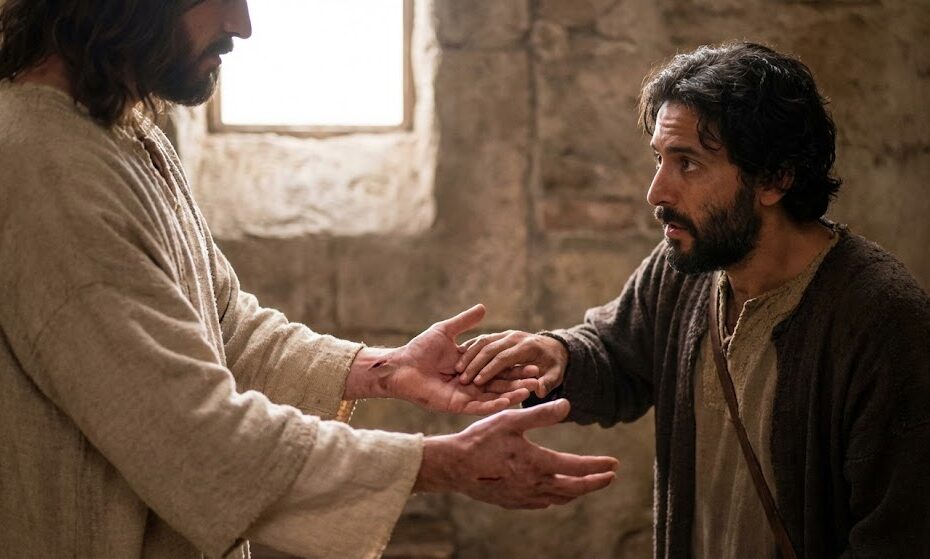
This is the same Father who showed His scars to Thomas after the resurrection, inviting him, “Put your finger here; see my hands. Reach out your hand and put it into my side” (John 20:27). Jesus invited Thomas to come face-to-face with His scars—the very marks of suffering and victory.
Jesus’ scars were not just wounds of pain; they were signs of love that conquered death, proof that brokenness can lead to new life. By inviting Thomas to touch His scars, Jesus showed that wounds are not to be hidden or feared—they are places where healing power flows and where faith is born.
In the same way, our scars—whether physical, emotional, or spiritual—are not things to be ashamed of or hidden away. They are places where God’s presence meets us tenderly, where His grace pours in. We find comfort in this: our scars connect us to a God who understands every ache because He is no stranger to it—because He aches, He weeps, He bleeds… and because He Himself bears scars.
Just as Jesus invited Thomas into His woundedness, He invites us into ours—not to leave us broken but to transform our pain into places of healing, hope, and strength. Thus, our scars—visible or invisible—are not barriers but doorways—doorways into His grace, where healing begins and His power is made perfect in weakness (2 Corinthians 12:9).
And so, in the depths of the girl’s despair, God became her refuge. Her scars, once sources of shame, became sacred doorways where His healing light poured in—transforming brokenness into beauty and pain into grace.
This is the God who walks with you, too—the One who meets you not despite your scars, but because of them. Isaiah proclaims, “By His wounds we are healed” (Isaiah 53:5). The scars of Christ are the source of our restoration, reminding us that God’s grace flows through brokenness, not despite it.
Every scar holds a story—mostly painful, mostly bitter—but not only of suffering and brokenness; they also tell of survival and healing. They stand as entry points, doorways for a healing Savior to enter—proof that we were never alone. The God who bears His own scars walks beside you, inviting you to trust His healing power and find peace in His faithful presence.
So instead of wishing our scars away, what if we looked at them through God’s eyes? What if we stood at those doorways and whispered, “Here is where the Lord came for me. Here is where He showed me mercy. Here, I trust Him.” Because the very places you thought would break you are the places where His presence shines through.
And beyond that, there is a deeper calling. Our scars connect us to others. They become
bridges of empathy and compassion, allowing us to reach out and hold the hands of those whosuffer. When we share our stories, our wounds invite others to bring their own brokenness into the light, reminding them they are not alone.
Our scars are badges of resilience and testimony to God’s faithfulness. They are proof that pain does not have the final word. Each mark is a chapter in a greater story—a story of redemption, hope, and unshakable love.
So, let us stop hiding the wounds and start embracing them as sacred doorways. Let us welcome the healing presence that waits patiently at the door to enter. For in those cracks, the light breaks in—and through the scars, grace flows freely, making us whole again.