Part 1 – A Story of Destruction, Hope, and Spiritual Decline
The history of God’s people is not just a record of events, but a reflection of human experience—loss, restoration, and the constant struggle of faith. The story we are about to consider reminds us that even in destruction, God begins a work of restoration.
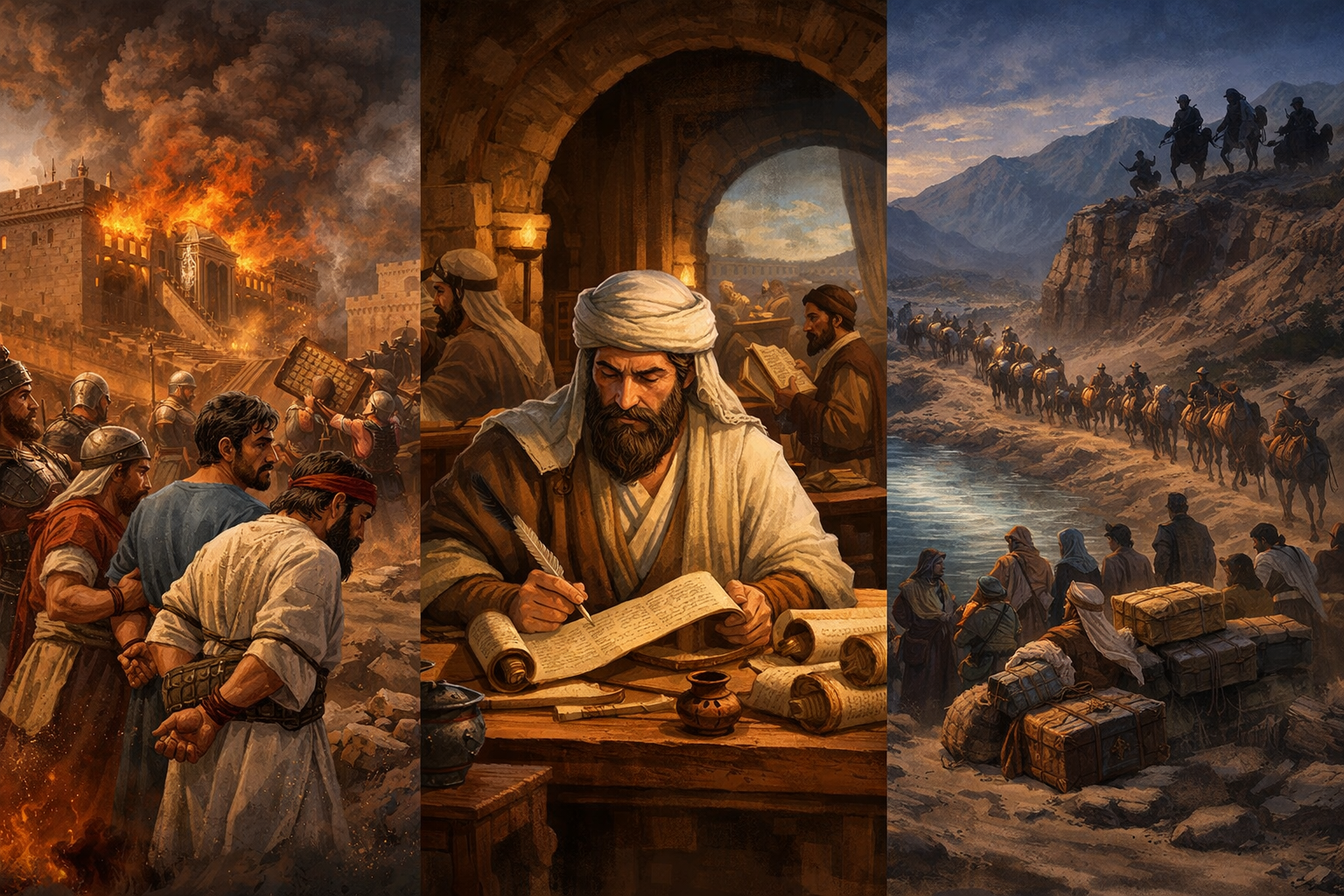
The Story begins as Nebuchadnezzar the king and Babylon destroy Jerusalem and the temple and takes all the wealth and property which is there in the temple with him. Besides this, he further takes the captives with him to Babylon in which accounts we see Daniel, his friends, and some of the Jews with him as captives.
A historian also said that
Jerusalem was systematically looted and destroyed. The walls were torn down, and the temple, the places, and all other places are burnt to the ground. – Pfandl.
The book of Ezra begins saying:
After about 67 years, God began to inspire the heart of Cyrus a Persian king who is ruling the Babylon.
This made the king to announce the first decree that Jews can go back to their homeland so called Jerusalem as freemen and to rebuild the temple of God. Only one group of people left.
In addition, the king also returned the articles of gold and silver which were brought by king Nebuchadnezzar for about 148 years ago.
Now this is a great news filled the heart of many Jews who are there in Babylon.
For about 50,000 people decided to set journey out of Babylon under the leadership of Zerubbabel.
While this group have Priests, Levites, Singers, Temple Servants, and common people.
Btw or This is the first group of people who left Babylon under Persian Empire.
Ezra chapter 3 explains the arrival of people to Jerusalem and the very first act they did is they build an alter and offered sacrifices. And
They laid the foundations of the temple which was once utterly destroyed.
As we go further into the story, Ezra 4 explains the problems which the first group of people experienced by the people who are staying the land in all these years.
These includes some heathen people while some became heathen because of the intermarriages and mixing or merging themselves with heathen religion.
They opposed the temple construction.
They discouraged the people.
They spread fear.
And due to which the rebuilding of temple stopped for about 14-16 years.
Chapters 5 and 6 of Ezra explains:
After long pause God sent His prophets like Haggai and Zechariah to rebuke the people and to encourage them to start rebuilding the temple of God.
In addition, God also inspired king Darius to give decree that no enemy should not interfere in the rebuilding process.
As a result of this the rebuilding of the temple finished, and people celebrated with joy and sacrifices. The Passover was celebrated.
As it says in Ezra 6: 19-22
19 On the fourteenth day of the first month, the exiles celebrated the Passover. 20 The priests and Levites had purified themselves and were all ceremonially clean. The Levites slaughtered the Passover lamb for all the exiles, for their relatives the priests and for themselves. 21 So the Israelites who had returned from the exile ate it, together with all who had separated themselves from the unclean practices of their Gentile neighbors in order to seek the Lord, the God of Israel. 22 For seven days they celebrated with joy the Festival of Unleavened Bread, because the Lord had filled them with joy by changing the attitude of the king of Assyria so that he assisted them in the work on the house of God, the God of Israel.
We do not know whether this is the first Passover which was kept since the time they were taken as captivities, but this is the first Passover recorded in the bible since the time they were taken as captives by king Nebuchadnezzar.
Meaning we can say the children of Isreal did not have the privilege of keeping the Passover for about 90 years.
Back to the story:
As time passed the children of Isreal grew cold in their religion.
They began to forget God and the law.
They began to have Inter marriages with foreign people.
Religious Apathy began and their worship became a heartless one. It just became a practice.
For about 50 to 60 years this practice has been continued. The basic life span of present day’s human.
Isn’t it the same what we experience in our present religion or present Christianity? A life at points seems so elevated with spirituality can often go darker at other times.
But God did not leave His people. This is the beauty of our God. He never forgets His people.
He never forgets when you are going through dark times, tough times.
He gives second chances.
He sends people to talk about His grace. He sends people to rebuke us.
The story reminds us that spiritual decline does not happen in a moment—it happens slowly, over time. Yet, even when people forget God, He never forgets them. The question we must ask ourselves is this: are we slowly drifting, or are we responding when God calls us back?